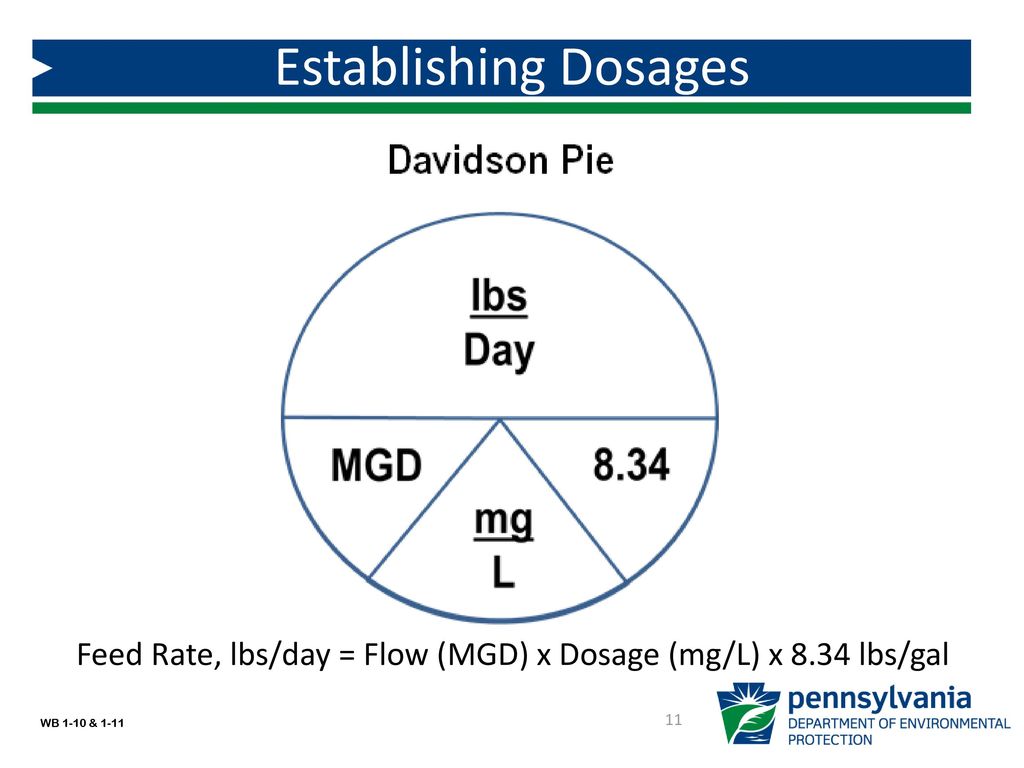
Feed+Rate,+lbsday+=+Flow+(MGD)+x+Dosage+(mgL)+x+8.34+lbsgal
Establishing Dosages. Establishing Dosages. Review the Establishing Dosages section. Chlorine dosage may be established from either bench scale laboratory testing, or actual measurement of field results from known plant operation. The results are suitable for establishing base feed rates however; real time corrections must be made to adjust for changing conditions. Since field conditions are not as controlled as laboratory tests, the actual dosage will generally be higher than those established in the laboratory. Calculations to determine the chlorine dosage and chlorine demand as established by field conditions are illustrated in example 1.1 in your workbook. Lead the participants through Example 1.1 to determine the chlorine dosage and chlorine demand, as outlined in the participant workbook pages 1-10 to Use a flip chart if necessary. Please print out WB pages 1-10 to 1-12 to follow while explaining the Davidson pie and how to interpret and use it to solve for any missing variable. Example 1.1: A chlorinator is set to feed 50 pounds of chlorine per 24 hours; the wastewater flow is at a rate of 0.85 MGD, and the chlorine as measured by the chlorine residual test after thirty minutes of contact time is 0.5 mg/L. Find the chlorine dosage and chlorine demand in mg/L. If no one has any questions, let’s move on to Breakpoint Chlorination. Next slide. Feed Rate, lbs/day = Flow (MGD) x Dosage (mg/L) x 8.34 lbs/gal. WB 1-10 & 1-11.